
Discover the intricate workings of zetasizers in measuring particle size and zeta potential. Unveil the principles of Dynamic Light Scattering and delve into the realm of Zeta Potential Measurements Zeta Potential test.
Explore the significance of Electrophoretic Mobility and the applications within Nanotechnology. Gain insights into the fundamental aspects of particle size analysis and how zetasizers are revolutionizing this field.
Join us as we unravel the mysteries of this cutting-edge technology.
Key Takeaways
- Dynamic light scattering analyzes size and movement of particles in a solution https://laballiance.com.my/.
- Zeta potential measurement provides information on surface charge and colloidal stability.
- Electrophoretic mobility measures particle migration under an electric field.
- Particle size analysis is critical for understanding particle characteristics and behavior.
Principles of Dynamic Light Scattering
Dynamic light scattering is a technique commonly used to analyze the size and movement of particles in a solution. By measuring the fluctuations in light intensity scattered by particles in Brownian motion, this method provides valuable insights into the dynamic behavior of particles in a sample.
Understanding these principles is crucial for researchers seeking to characterize the properties of colloidal systems, nanoparticles, and macromolecules. Through the analysis of the intensity autocorrelation function, information regarding particle size distribution and diffusion coefficients can be obtained.
This non-invasive method offers a quick and efficient way to study the behavior of particles in suspension, making it a valuable tool in various fields such as chemistry, biology, and materials science.
Understanding Zeta Potential Measurements
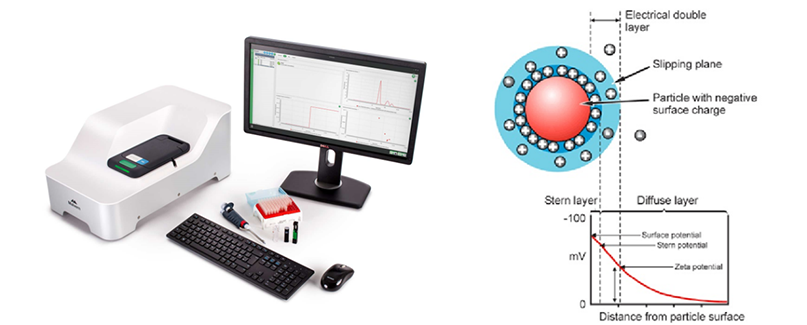
Building upon the principles of dynamic light scattering discussed earlier, the measurement of zeta potential provides crucial information about the surface charge of particles in a solution. Zeta potential, represented by the Greek letter ζ, indicates the stability of colloidal dispersions.
A high absolute zeta potential value suggests strong repulsive forces between particles, preventing agglomeration and ensuring dispersion stability. Conversely, a low zeta potential may lead to particle flocculation.
Zeta potential measurements are essential in various industries, including pharmaceuticals, cosmetics, and food, as they influence product performance and stability. By understanding zeta potential, manufacturers can optimize formulations and enhance product quality, ultimately meeting consumer demands for effective and reliable products.

Analyzing Electrophoretic Mobility
The analysis of electrophoretic mobility provides valuable insights into the behavior of particles in a solution. By measuring the velocity at which charged particles migrate under an electric field, their surface charge and interactions can be understood.
Electrophoretic mobility is crucial in studying colloidal stability, as particles with higher mobility tend to repel each other, preventing aggregation. This information aids in optimizing various processes like drug delivery, cosmetics, and food production.
Additionally, electrophoretic mobility measurements contribute to determining zeta potential, a key parameter in assessing particle stability. Understanding these dynamics is essential for controlling the dispersion, aggregation, and stability of particles in suspension, ultimately influencing product performance and quality.
Importance of Particle Size Analysis
Particle size analysis plays a critical role in understanding the characteristics and behavior of particles in various applications. By determining the size distribution of particles in a sample, researchers and industries can optimize processes such as drug delivery, food production, and material synthesis. The particle size affects properties like stability, dissolution rate, and texture, impacting the overall quality of products.
For example, in pharmaceuticals, small changes in particle size can significantly alter drug performance. Additionally, in environmental studies, understanding the size of pollutants is essential for assessing their transport and potential impact. Therefore, accurate particle size analysis is vital for ensuring product quality, efficiency in processes, and minimizing adverse effects on health and the environment.
Applications in Nanotechnology
In the realm of nanotechnology, precise control of particle sizes is indispensable for achieving desired material properties and applications. The Zetasizer’s ability to accurately measure particle size and zeta potential plays a crucial role in various nanotechnology applications.
In drug delivery systems, understanding the size distribution of nanoparticles is vital for optimizing drug loading and release kinetics. Additionally, in nanomaterial synthesis, controlling particle size is crucial for achieving specific mechanical, electrical, or optical properties. Nanoparticles with well-defined sizes can also enhance the performance of sensors, catalysts, and electronic devices.
Conclusion
In conclusion, the Zetasizer utilizes Dynamic Light Scattering to measure particle size and Zeta Potential, providing valuable insights into the characteristics of particles in solution.
By analyzing electrophoretic mobility and understanding the principles of these measurements, researchers can gain a deeper understanding of particle behavior and make informed decisions in various fields such as nanotechnology.
The Zetasizer plays a crucial role in particle size analysis and has a wide range of applications in research and industry.